

Why the Period Costume Stops at the Ankle Between Takes
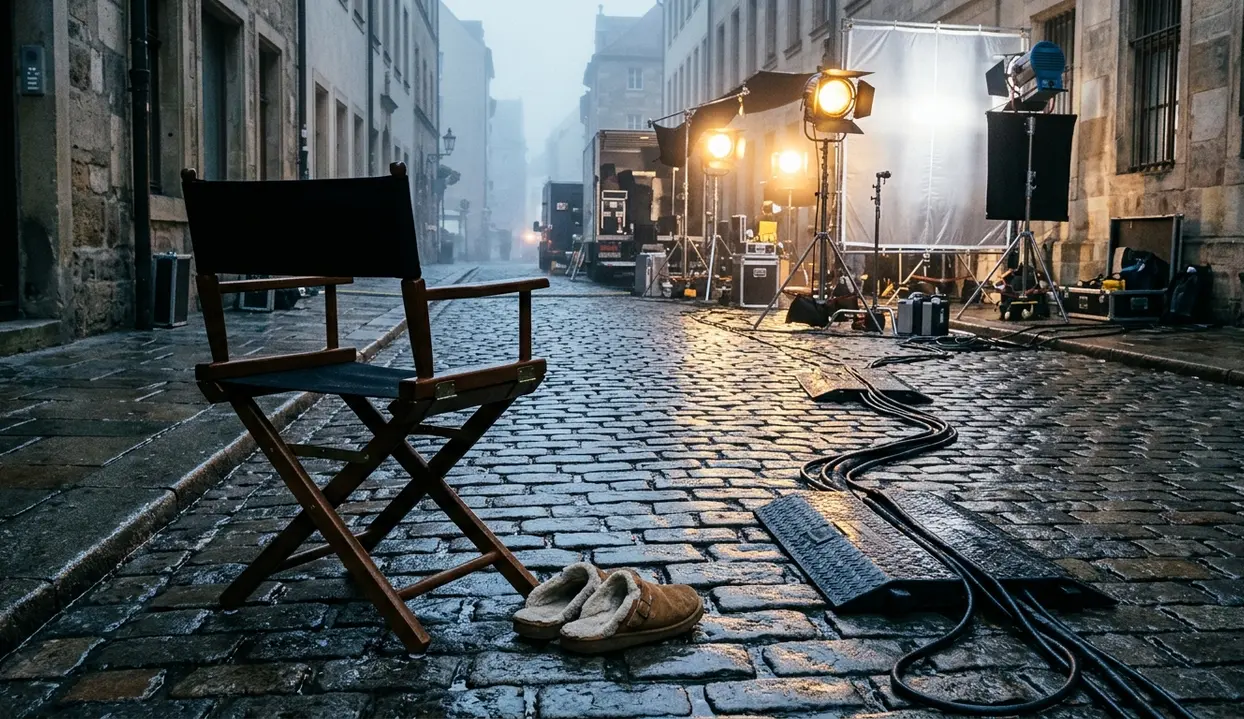
At dawn on a damp city pavement outside a production basecamp, an actor steps down from a wardrobe trailer wearing a floor-length wool period coat, tailored waistcoat, and silk cravat. Beneath the hem, where vintage leather brogues should sit, a pair of thick-soled taupe suede clogs strikes the wet asphalt. This visual jarring is a documented constant across entertainment news archives and candid location photography. The moment a director calls cut, principal performers step out of character-specific footwear and slide directly into three distinct off-duty silhouettes: shearling-lined boots, ergonomic recovery clogs, and high-cushion stability sneakers.
While red carpet fashion analysis typically focuses on custom couture and formal eveningwear, on-set street style operates under strict mechanical and physiological benchmarks. Camera and lighting resets between master shots and close-up coverage routinely leave cast members standing on damp pavement or unheated soundstage concrete for 20 to 45 minutes at a stretch. Consequently, standby costumers and set dressers carry heavy-duty canvas shoe totes packed with twin-gore suede clogs and collapsible-heel mules right up to the edge of the camera frame.
Costume supervisors evaluate between-take footwear using three primary criteria:
- Hands-free step-in speed: Footwear must be kicked off or stepped into beside a camera dolly without the performer looking down. Lace-up ankle boots and buckled loafers are ruled out during pre-production fittings because untying knots delays the final wardrobe check before the bell rings.
- Thermal regulation: Stationary waits during exterior night shoots require immediate insulation that traps body heat without altering the fit of costume hosiery.
- Subfloor shock absorption: Unyielding concrete stages demand high-rebound midsoles or anatomically contoured footbeds to prevent lower-extremity fatigue across long shooting blocks.
Shearling Boots and Insulated Mules for Early Call Times
Overnight exterior shoots and dawn call times between 4:30 AM and 6:00 AM expose stationary feet to asphalt temperatures that drop rapidly before sunrise. Paparazzi archives from winter location shoots in New York, Toronto, and London consistently show performers waiting near heat lamps in two specific cold-weather lines: classic sheepskin silhouettes—specifically the UGG Classic Short and the low-profile UGG Tasman—and quilted synthetic slippers such as The North Face ThermoBall Traction Mule.
The preference for these models inside professional wardrobe departments stems from structural clearance rather than casual aesthetics. During early-morning blocking rehearsals, standby costumers prioritize wide-collar sheepskin shafts and backless quilted mules so performers encased in rigid period corsetry, prosthetic suits, or multi-layered outer coats can step directly into thermal insulation hands-free. Bending at the waist to pull on a narrow boot shaft risks popping delicate seam allowances, creasing pressed wool trousers, or disturbing microphone packs wired along the torso.
Inside the boot, material engineering protects the visual continuity of the costume. Twin-face Grade-A sheepskin uppers lined with nearly 17-millimeter shearling fleece or synthetic blown-insulation baffles trap body heat around the Achilles tendon without compressing delicate silk hosiery or period-accurate wool stockings. When the bell rings for rolling, the actor slides out of the wide collar without friction, leaving fragile costume socks intact.
Cold-Weather Street Style Translation
To adapt this production utility for everyday winter errands, pair low-profile platform shearling mules like the UGG Tasman with relaxed wide-leg denim or heavy fleece trousers. The wide hem drapes cleanly over the open heel counter, delivering the thermal retention of a full boot with the slip-on speed required for quick transitions indoors.
Contoured Cork Clogs and High-Stack Recovery Slides on Soundstage Floors
When production moves from frigid exterior streets onto climate-controlled interior soundstages, the primary occupational hazard shifts from hypothermia to sustained vertical load. Multi-camera blocking and overhead rigging adjustments frequently keep principals standing near their floor marks for 3 to 5 hours during an afternoon shooting block. Under these conditions, wardrobe teams transition actors out of thermal shearling and into open-backed cork-latex footbeds or single-piece injection-molded EVA slides.
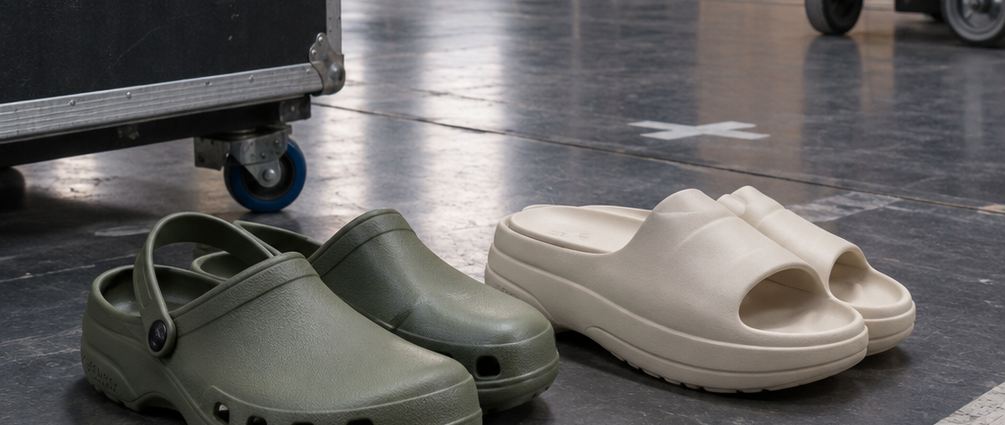
Candid lot photography outside major studio stages highlights a sharp split between two biomechanical tools: structured suede clogs, led by the Birkenstock Boston soft-footbed model, and oversized athletic recovery slides, primarily the Hoka Ora Recovery Slide and the Oofos OOahh. Both categories address the unyielding flatness of poured concrete subfloors. Deep heel cups paired with contoured suede-lined cork footbeds and dual-density oversized rocker soles absorb static vertical load while redistributing pressure away from the metatarsal heads. By elevating the arch and cradling the calcaneus, these silhouettes prevent the plantar fascia from flattening during multi-hour lighting tweaks.
However, set safety coordinators prohibit open-back recovery slides and loose-fitting clogs during active stunt sequences, wet-down rain effects, or scenes filmed around moving technocranes where closed-toe traction is mandatory. Outside of those high-risk setups, the choice between cork and injection-molded foam dictates how seamlessly an actor transitions from the studio lot to off-duty street style.
Oiled Leather and Suede Clogs vs. Athletic Recovery Foam
While both silhouettes resolve soundstage foot fatigue, their visual utility outside the studio gates diverges sharply:
- Structured Cork Clogs (Birkenstock Boston): Constructed with oiled leather or brushed suede uppers over a firm cork-latex chassis, these models bridge on-set utility and editorial street style. Actors frequently keep them on after wrap, pairing taupe or espresso suede clogs with tailored trousers, vintage denim, and heavyweight knitwear for candid coffee runs.
- High-Stack EVA Slides (Hoka Ora, Oofos OOahh): Built from massive blocks of compression-molded foam with aggressive rocker geometry, these slides function strictly as mechanical recovery equipment. Their bulbous, monochromatic profiles remain confined to dressing rooms, wardrobe trailers, and immediate post-wrap transit.
Plush Stability Sneakers Built for Poured Concrete and Cobblestones
Location filming in dense urban centers introduces a third logistical challenge: long-distance transit between basecamp trailers, holding areas, and locked-off exterior sets. When actors must walk several city blocks over uneven cobblestones or broken pavement while dressed in full costume, open-backed mules and slides lack sufficient ankle containment. For these transits, wardrobe assistants assign neutral-toned mesh stability runners and technical trail hybrids—most notably the New Balance 990v6, the Hoka Clifton series, and the Salomon XT-6.
These specific models dominate set photography because their closure systems and color palettes align with production workflows. Performers rely on quick-pull toggle laces, as seen on the Salomon XT-6, or plush gusseted tongues on heritage New Balance runners that allow the foot to slide in and secure the midfoot without tedious lacing adjustments. Visually, costume departments stock these trainers in muted grey, cream, or core black colorways. These understated tones sit quietly beneath costume hems and avoid clashing with the high-visibility parkas worn between takes, making them effortless staples in off-duty celebrity street style.
Beneath the breathable mesh uppers, the mechanical necessity of these trainers becomes unmistakable when measured against traditional costume cobbling. Standard union filming days span 12 to 14 hours from hair-and-makeup call to final wrap, requiring footwear that prevents lower-back compression across the entire shooting schedule. Swapping out of flat-soled period leather boots—which provide just 4 to 6 millimeters of compressed veg-tan outsole—into a maximalist running trainer immediately places 32 to 38 millimeters of dual-density supercritical EVA and polyurethane rim foam beneath the calcaneus.





Your Thoughts
No comments yet. Be the first!
Your Comment