


The Verdict: When Shock Value Becomes the Uniform
At a winter award-season arrival, crystal-embellished tulle seems to cover the carpet from one camera mark to the next. Nude mesh, scattered stones, and strategically placed appliqué merge into a single glittering field. Then a sharply tailored architectural gown enters the frame. Its opaque surface and controlled volume command attention before the wearer reaches the first bank of photographers.
The naked dress no longer disrupts red carpet convention. Repetition has turned a once-confrontational silhouette into a predictable baseline. Transparency still creates an immediate image, but immediacy and innovation have separated. The stronger fashion proposition now comes from weight, geometry, and construction that remains legible at a distance.
That judgment reflects a practical shift observed during the winter award cycle. Stylists curating opening visual sequences bypassed familiar racks of crystal tulle in favor of heavily structured gowns. Internal corset boning measuring something like 4.5 to 6 millimeters supported silk gazar and established a firmer outline.
Disruption Moves Inward
The relevant question has changed. Exposure once supplied the tension: how much could a dress reveal while retaining the ceremonial language of eveningwear? Contemporary critique asks how the garment stands, turns, and occupies space. A rigid neckline, cantilevered hip, or curved satin panel can disturb expectations without depending on visible skin.
The New Baseline
A memorable red carpet dress now needs a structural idea that survives beyond the first revealing photograph.
How the Sheer Silhouette Reached Visual Saturation
The sheer gown followed a clear trajectory over the past decade. Early appearances generated entertainment news because they challenged the expected boundary between underwear, evening dress, and the body. Once designers, stylists, and celebrity teams repeated the formula across galas, premieres, and award ceremonies, the challenge became convention.
Archival tracking recorded 412 distinct sheer-gown appearances at major entertainment galas between February 2014 and November 2023. That count measures recurrence rather than audience sentiment, and it cannot establish how every viewer interpreted each dress. It does, however, clarify the scale of repetition confronting an editorial team scanning a season as a visual sequence.
Why Repetition Weakens the Image
Visual fatigue begins when the viewer can predict the organizing device before examining the garment. With many naked dresses, the eye identifies transparency first, embellishment second, and construction only afterward. The body supplies the dominant line. Variations in bead placement or nude illusion mesh may register as decoration rather than a new silhouette.
Fashion critique has consequently moved closer to first principles. Editors increasingly test whether a gown establishes proportion, controls volume, and demonstrates precise tailoring. Under that method, skin-baring audacity carries less analytical weight than the cut of an armhole or the stability of a sculpted bodice. The sheer dress can still be beautiful; sheer exposure alone now offers a thin critical argument.
Heavy Fabric Gives Couture Its Architecture
Structural couture starts with resistance. Fine tulle follows the body and responds quickly to air, movement, and gravity. Duchesse satin, silk gazar, and structured velvet can hold a line away from the body, allowing the designer to treat empty space as part of the garment.
Building a Shape That Can Stand
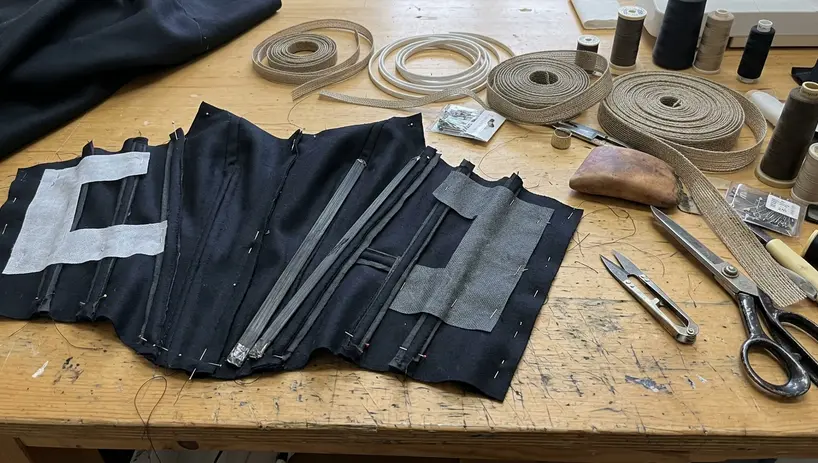
Designers calculated the drape behavior of heavy textiles before selecting internal support. Twelve-ply silk gazar supplied body, while rigid horsehair braid anchored the hemline. Without that anchor, the geometric silhouette collapses under the unforgiving illumination of a step-and-repeat.
- Duchesse satin supports broad curves and creates a dense, light-responsive surface.
- Silk gazar holds lifted folds, projecting volume without requiring a solid exterior shell.
- Structured velvet absorbs light across flat planes while defining deep shadows at seams and bends.
These materials shift design attention toward internal engineering. Boning directs force through the bodice. Interfacing stabilizes a plane. Horsehair braid preserves the edge of a wave or flare. The result can stand partly independent of the wearer, continuing the historical evolution of architectural couture through contemporary fabrication.
Transparency in Context
Sheer fabric remains valuable for sleeves, layered panels, and textural contrast. Its period as the sole focal point of a high-fashion red carpet look has passed. This argument applies specifically to formal celebrity appearances, not casual street style or performance activewear.
Modern Sartorial Risk Comes From Shape
A celebrity wearing a gravity-defying gown accepts a different kind of exposure. The garment may widen the shoulders, conceal the waist, interrupt conventional proportions, or restrict movement. Such decisions ask viewers to encounter the dress as an autonomous object rather than a decorative frame for the body.
That choice carries real risk on a red carpet. A complex silhouette can appear severe from one camera position and extraordinary from another. It also resists the easy approval generated by sparkle and visible skin. The audience must spend time reading its planes, shadows, and points of suspension.
The Camera Reads Volume Differently
Photographers adapted to this structural turn. Key lights set at a 45-degree downward angle emphasized the sculptural depth of heavy fabrics. The light skimmed raised satin, dropped into velvet recesses, and separated projecting forms from the step-and-repeat behind them.
- The front view establishes the gown's principal geometry and balance.
- A three-quarter angle reveals how far panels extend from the body.
- Turning the frame converts rigid folds into changing fields of highlight and shadow.
Flat sheer fabric often gives photographers a consistent surface across those views. Architecture produces distinct images with each shift in position. That quality suits a broader appetite for visible craftsmanship: viewers can trace how a seam redirects volume, how a bodice carries weight, and how the garment negotiates gravity. The strongest editorial photograph records both celebrity presence and design intelligence.
The Next Red Carpet Begins at the Dress Form
Engineering determines whether an architectural concept survives the walk from fitting room to camera line. Heavy gowns also impose physical constraints. The current shift belongs primarily to indoor, climate-controlled venues kept below 72 degrees Fahrenheit, where heat is less likely to warp fabric or exhaust the wearer.
Resistance Becomes the Design Tool
Master tailors shaped thick duchesse satin over custom-molded dress forms. Manipulating the cloth required 18 pounds of tension, more or less. The measurement describes the central fact of this aesthetic: the material pushes back.
In a dim atelier, a tailor braces one hand against the dress form and drives rigid boning into a rising wave of satin. Pins mark the intended curve at close intervals. Overhead light catches the crest while the underside falls into a hard shadow. The tailor steps back, studies the angle, then removes one pin and sets it slightly higher.
The satin resists again. This time the curve holds.











Your Thoughts
No comments yet. Be the first!
Your Comment