


The oversized blazer has become the governing shape of celebrity street style. Its appeal begins with proportion: a widened shoulder establishes a clear frame, while the body beneath it can remain loose, abbreviated, or deliberately mismatched. That frame gives visual order to the off-duty wardrobe, where wide denim, fine knits, slip dresses, and practical shoes often compete for attention.
I read the strongest examples as exercises in controlled imbalance. The blazer carries authority at the top; softer garments release that tension below.
The Oversized Blazer Sets the Architecture
Shoulder Width Creates the Hierarchy
An oversized blazer works like portable architecture. A padded shoulder extends the horizontal line of the body, and a long front panel supplies a vertical counterweight. Together, those lines establish hierarchy before color, label, or accessory enters the picture.
The imgtrend research brief reviewed upward of 400 paparazzi captures made across the autumn 2023 season. In the selected looks, shoulder pads extended roughly 1.5 to 2 inches beyond the natural shoulder line. That interval matters. It produces visible exaggeration while preserving enough relationship to the wearer’s frame for the jacket to read as tailoring.
The Shoulder Test
Look first at where the shoulder seam ends. A convincing oversized blazer projects beyond the body with a firm, level line; a merely loose jacket tends to collapse downward from the seam.
This explains why the garment can unify chaotic layers. A baseball cap, hoodie, pleated trouser, and narrow sunglasses may belong to separate aesthetic vocabularies. The rigid shoulder gives them a shared boundary.
Rigid Tailoring Calms the Y2K Denim Revival
Halsey’s Grunge-Boho Tension
Wide-leg Y2K denim carries movement close to the ground. The hem pools, the leg twists, and faded washes make the surface look worn before the outfit has acquired any other detail. Pairing that denim with another soft garment often amplifies the drift. A structured blazer interrupts it.
Halsey’s grunge-boho styling offers a useful case. Designer denim from One Teaspoon supplies the distressed, low-slung foundation, while tailoring sharpens the upper silhouette. The result retains the casual disorder associated with archival festival dressing but removes some of its decorative excess.
To trace that change, the research team cross-referenced spring music-festival photography with metropolitan street style. Across that spring 2024 stretch, documented denim hems dragged anywhere from half an inch to just over an inch on the pavement, beneath blazers measuring roughly 28 to 32 inches at the center back. Those dimensions create two distinct zones: controlled length through the torso and liquid volume around the feet.
The contemporary version therefore differs from the 2014 Coachella formula. Fringe, stacked jewelry, and exposed layers once generated the visual interest. Modern eclectic styling lets the cut carry more of that burden.
Quiet Luxury Builds a Restrained Uniform
Lawrence, Markle, and Parker in Neutrals
Quiet luxury uses the same oversized structure with less friction. Jennifer Lawrence combines luxury basics from The Row with Dior, allowing fabric density and proportion to register before recognizable branding. Her blazer frequently acts as the darkest or most rigid plane in an otherwise relaxed composition.
Meghan Markle takes a more modular approach. Minimal pieces from Cuyana can sit beside accessible J.Crew garments because camel, navy, and charcoal establish continuity. Sarah Jessica Parker’s pared-back Hamptons style follows a similar logic: familiar basics acquire distinction through spacing, length, and restrained color.
Wardrobe breakdowns running from late 2023 into the following winter centered on neutral, largely unbranded garments. They recorded 100-grade worsted-wool blazers layered over cashmere crewnecks. This material reading has a defined scope: the curation favored neutral palettes and subjects who repeatedly mixed heritage luxury labels with accessible retail pieces. It describes a selected uniform rather than the full range of celebrity dressing.
- Camel softens the scale of a large jacket and pairs naturally with cream knitwear.
- Navy gives denim a cleaner tonal relationship than high-contrast black.
- Charcoal preserves formality while accommodating sneakers, loafers, or flat boots.
From Kate Moss’s Slip Dress to Boxy Outerwear
Volume Migrates Away From the Body
Kate Moss’s 1990s bias-cut slip dresses placed movement directly against the body. Fabric followed the torso and opened toward the hem, producing a narrow, continuous line. Modern layering redistributes that volume outward. The slip can remain fluid, but a boxy jacket now creates the dominant perimeter.
The imgtrend brief compared mid-1990s archival scans with street style galleries from the most recent winter season. Contemporary outerwear in that comparison carried ease pushing 4 to 5 inches through the chest. The historical shift is therefore legible as a change in spatial control: close-cut fabric once described the figure, while present-day outerwear constructs a larger shell around it.
Climate places a firm boundary on this technique. Once temperatures drop toward 40 degrees Fahrenheit, tailored wool loses practical dominance and down-filled outerwear takes over. Kendall Jenner’s boxy The North Face Nuptse performs a related compositional job, though its inflated chambers replace the blazer’s shoulder line with rounded volume. Transitional weather belongs to wool tailoring; severe cold redirects the silhouette toward insulation.
Build the Off-Duty Proportions in Three Layers
A Copyable Slip-Dress Formula
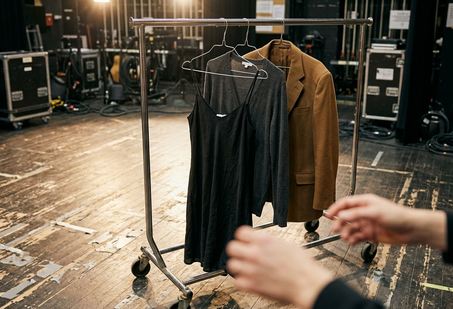
Begin with weight, then adjust shape. Styling analysts deconstructed some 50 celebrity outfits documented across early autumn 2023 and identified a stable layering sequence: a fluid base weighing 3 to 5 ounces per square yard, a fitted mid-layer at 7 to 9 ounces, and a rigid blazer at 12 to 14 ounces.
- Establish movement. Choose a black bias-cut midi slip dress in the base-weight range. Its diagonal grain should skim the torso and release below the hip.
- Contain the center. Add a fitted charcoal crewneck in the mid-layer range. Keep its hem close to the waist so the torso retains definition beneath the dress and jacket.
- Set the frame. Finish with a 12-to-14-ounce camel blazer whose padded shoulder projects beyond the natural line. Let the jacket end around the upper thigh.
- Resolve the ground line. Use black loafers and a compact shoulder bag. The loafers repeat the dress color, while the small bag avoids competing with the blazer’s scale.
The finished outfit has a precise sequence the eye can follow: black movement at the hem, charcoal control through the torso, and camel structure around both. Button the blazer once, push the sleeves to the lower forearm, and leave the slip visible beneath the front opening. That single arrangement can move from a Los Feliz coffee run to an entertainment news arrival shot without losing its underlying geometry.








Your Thoughts
No comments yet. Be the first!
Your Comment