

Every autumn, the same question shows up in my inbox from readers who have just watched a downtown coffee run turn into a viral street style frame: what is actually holding that outfit together? The answer is almost never the sneakers or the sunglasses. It is the jacket, and more precisely, the way the jacket is cut.
Transitional weather punishes indecision. Close to fifty-two degrees at eight in the morning, nearly seventy-one by two in the afternoon, and a wind corridor between two buildings that erases both numbers. The wardrobe response most people reach for is accumulation: a shell, a vest, a fleece, a packable down layer. The response I keep photographing on off-duty actors and models is closer to subtraction.
Contents
- Three Jackets Beat Twelve Micro-Layers
- Why the Oversized Leather Bomber Behaves Like a Thermostat
- Twelve-Ounce Canvas and the Bagless Errand Run
- Unlined Lyocell, the Belt, and Movement in the Frame
- Building the Bomber Stack, Layer by Layer
Three Jackets Beat Twelve Micro-Layers
The original plan for this piece was a taxonomy of specialized micro-layers: grid fleece, waffle thermal, quilted liner, wind shell. That catalog collapsed under its own evidence. Drawing on an archive of approximately 450 candid street style photographs shot in New York and Los Angeles between late September and early November 2023, the recurring pattern was not layer count but silhouette discipline. Stylists working with high-visibility clients bridge the seasonal gap with three architecturally sound mid-weight jackets, and they repeat them.
Those three archetypes: the voluminous leather bomber, the utilitarian canvas chore coat, and the unstructured trench.
Each solves a different problem. The bomber manages fluctuating dry heat. A chore coat carries cargo and holds a rigid frame. The trench handles length, movement, and the visual drama that a long lens rewards. What none of them do is depend on a hidden stack of technical fabrics to function. The outer shell is the architecture; everything underneath is tuning.
Silhouette Over Stockpile
If a transitional jacket only works when three specific base layers sit beneath it, the jacket is doing too little. The garments that survive repeated photographic exposure look correct over a t-shirt and correct over a cardigan, without a change in shoulder line.
Why the Oversized Leather Bomber Behaves Like a Thermostat
The oversized leather bomber is the most photographed of the three, and the most misunderstood. Read as a style choice it is retro shorthand. Read as an engineering problem it is a variable-volume air chamber.
The mechanism sits in the shoulder. Observed cuts consistently extended the shoulder seam in the range of 2.5 to 3.5 inches past the natural shoulder line. That drop creates a standing column of air across the upper back and under the arms. Worn open, the column vents continuously as the wearer moves, which is why you see actors crossing a parking lot at noon in full leather without visible heat stress. Zipped, the same volume becomes a sealed wind barrier, and the trapped air does the insulating work that a quilted liner would otherwise perform at twice the bulk.
Finish matters as much as cut, for reasons that have nothing to do with taste. Glossy hides throw hard specular glare under midday sun, and in paparazzi frames that glare reads as visual weight, flattening the garment into a bright slab. Treated matte and lightly distressed leathers absorb that light. The jacket keeps its dimensionality in the photograph, which is the entire point of a silhouette built on volume.
Coastal Rain Warning
Untreated leather bombers belong in dry, fluctuating climates. Heavy coastal precipitation degrades a distressed matte finish quickly, leaving water-marked panels and a stiffened hand that no conditioning fully reverses. Los Angeles in October is the use case. A November storm front on the Atlantic is not.
Twelve-Ounce Canvas and the Bagless Errand Run
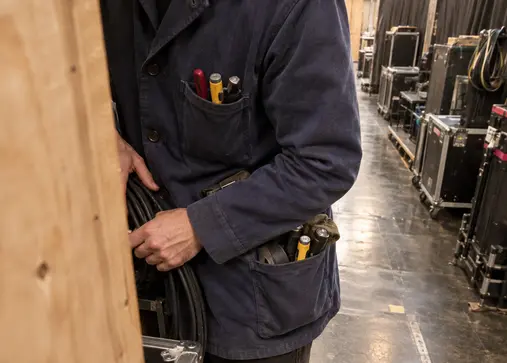
The French worker's jacket arrived in celebrity street style through the back door, by way of workwear resale and menswear obsessives, and it has stayed because it does something no soft luxury fabric can replicate. Weight.
Canvas sourced in the 12 to 14 ounce range holds a rigid architectural frame. Observation made the distinction plain: the same chore coat pattern cut in a softer luxury cotton collapses against the torso the moment a knit goes underneath, while heavyweight canvas maintains an identical exterior line over a t-shirt or a thick shawl cardigan. The garment stops reporting on what is beneath it. That independence is the whole appeal for anyone whose outerwear is photographed from twenty feet away across the street.
Then there is the pocket question. Tracking off-duty actors through routine errands, the pattern that stood out was behavioral rather than sartorial: oversized patch pockets replaced the bag entirely. Phone, keys, wallet, sunglasses, a folded call sheet. Four patch pockets on a structured canvas frame carry that load without sagging, because the canvas resists the downward pull that would wreck a lighter shell. No tote, no crossbody, nothing swinging across the chest to interrupt the line.
Unlined Lyocell, the Belt, and Movement in the Frame
The trench has been quietly stripped down. Military-grade gabardine built a coat designed to stand up to trench warfare and, later, to stand still on a red carpet. The version now moving through street style is unlined, cut in lightweight wool blends and lyocell, and it moves.
Architectural drape analysis of unlined lyocell trenches recorded a reduction of 1 to 2 pounds against comparable traditional gabardine. That difference is not comfort trivia. It changes the coat's behavior in motion. A lighter unlined panel lifts at walking pace and trails slightly behind the stride, producing the sweeping diagonal that photographers chase and that a heavier coat simply cannot generate below a run.
The belt is where technique enters.
Cinch, Don't Button
Fasten the belt at the waist and leave the button placket entirely open. The front panels then fall away in two independent sheets while the waist stays defined, producing controlled asymmetrical volume. Knot the belt rather than buckling it; a buckled belt sits flat and symmetrical, which kills the effect.
Building the Bomber Stack, Layer by Layer
Here is the exact sequence, reverse-engineered from off-duty model layering. Copy it directly.
- Base: A fitted lightweight cotton crewneck in white or washed black. Fitted is doing real work here. Any excess fabric at the base migrates upward and disrupts the two layers above it.
- Mid: A fine-gauge merino wool cardigan, buttoned from the collar down with the bottom two buttons left undone. That leaves a 3 to 4 inch opening at the hem for mobility, which prevents the cardigan from bunching at the waist when you sit, drive, or lift your arms. Fine-gauge specifically; a chunky knit adds shoulder bulk and destroys the drop-shoulder geometry.
- Outer: A vintage-cut oversized leather bomber in matte or lightly distressed hide, shoulder seam landing 2 to 4 inches past your natural shoulder. Drape it on rather than pulling it tight. Check the mirror at a three-quarter angle: the shoulder seam should sit clean over the cardigan with no pull line across the upper arm.
- Bottom: Straight-leg denim, mid to dark wash, no taper. The upper-body volume needs a vertical column beneath it, and a tapered leg turns the whole stack into a triangle.
- Footwear: Low-profile leather loafers. Anything with a chunky sole competes with the bomber for visual mass and the composition splits in two.
Run it once at 55 degrees on an overcast morning. Bomber open through the walk, zipped on the exposed corners, cardigan carrying the load if the sun never arrives.








Your Thoughts
No comments yet. Be the first!
Your Comment