
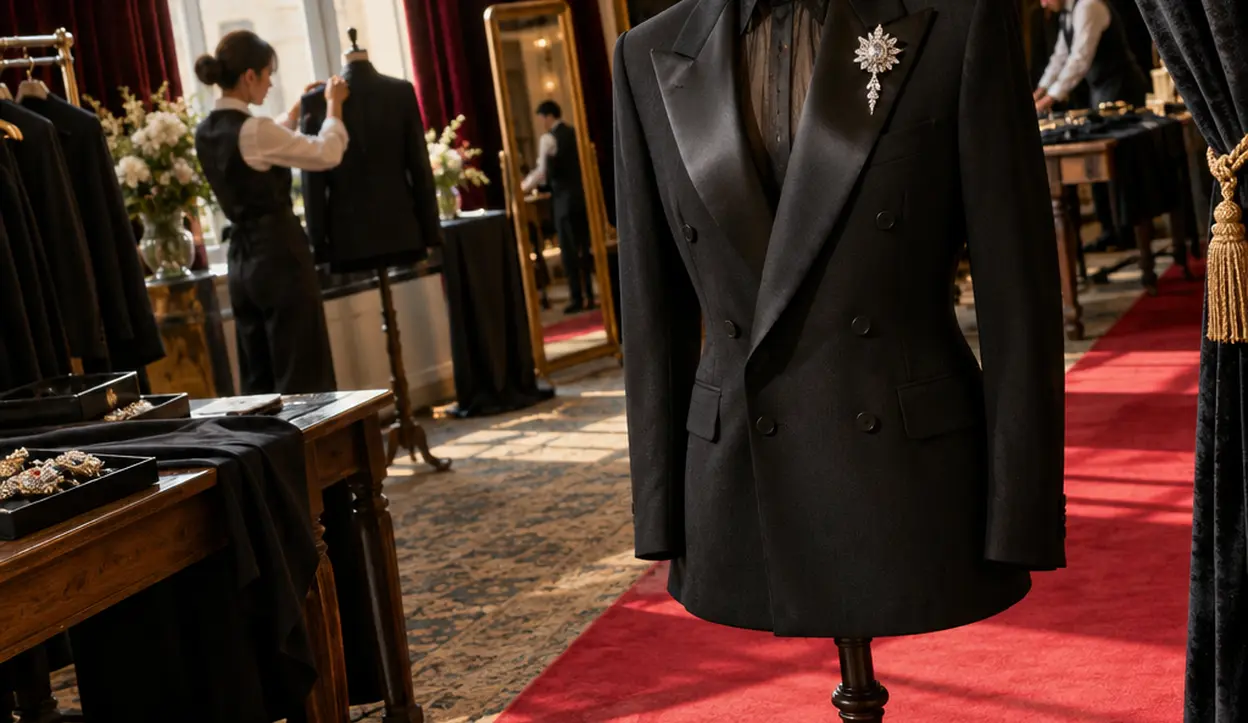

From Background Uniforms to the Primary Visual Focal Point
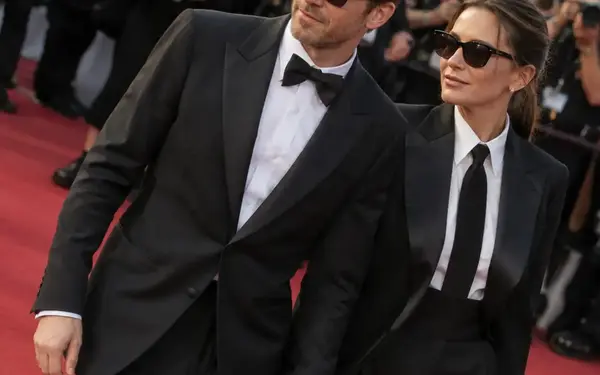
For decades, strict black-tie codes enforced a rigid uniformity across premiere photography. Male nominees operated as a monochromatic backdrop, clad in identical penguin suits while floor-length couture gowns monopolized fashion commentary and editorial space. Standard black-tie combinations rely on a continuous dark wool outer shell and a rigid white cotton piqué chest V, a formula that flattens individual silhouettes into a single visual plane whenever a group stands together under direct camera flash.
That dynamic has inverted. Experimental menswear now commands the sharpest visual impact at major award shows through four structural interventions: proportion play, lapel hardware, sheer shirting, and archival tailoring.
Viewing the press line from my vantage point, the predictable geometry of a standard peak-lapel tuxedo vanishes next to high-contrast architectural choices. Evaluating whether a formal look recedes into the background or acts as a primary focal point depends entirely on silhouette disruption and directional light capture along the upper torso. A shifted waist seam, an exposed collarbone, or a cluster of diamonds pinned through heavy wool creates physical gaps, texture shifts, and specular highlights that separate the wearer from the step-and-repeat wall.
Many stylists still misread this shift by treating color swaps as structural experimentation. Replacing black Barathea wool with emerald or burgundy velvet while keeping a conventional slim fit, a stiff white bib shirt, and a satin bow tie preserves the conservative template. True visual dominance requires altering the garment's underlying architecture.
Architectural Proportion Play and the Rise of Archival Tailoring
Altering the geometry of formal menswear requires shifting the horizontal division of the body. The pinched, slim-fit tailoring that dominated the early twenty-first century has given way to cropped double-breasted jackets, exaggerated drop shoulders extending past the acromion bone, and high-waisted, wide-leg wool trousers that dramatically elongate the lower body. A cropped jacket and high-waisted trouser combination hits its intended visual proportion when the jacket hem terminates right at or slightly above the natural iliac crest. This cut completely conceals the shirt waistband and establishes an unbroken vertical column down the leg.
Pairing wide-leg, high-waisted trousers with a standard-length slim jacket ruins this effect. The longer hem bisects the torso at the wrong horizontal axis and forces the jacket skirt to flare awkwardly over the expanded volume of the trouser pleats.
Kinetic Drape Versus Static Couture
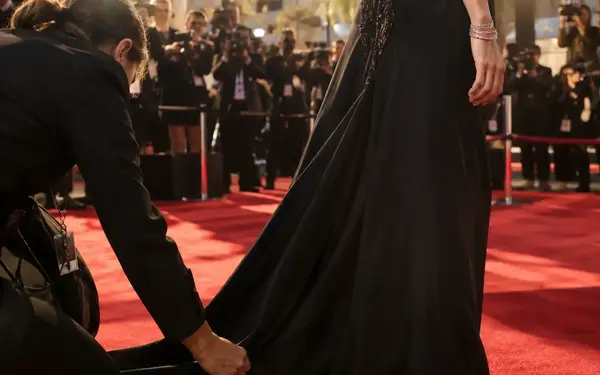
On the carpet, the visual competition between experimental tailoring and traditional eveningwear comes down to movement. Heavily boned couture gowns guarantee a sculpted, static outline when the wearer stands motionless for photographers, yet those internal corsets and crinolines restrict the stride and require publicists to manually arrange trains on the floor every few feet. Wide-leg pleated heavyweight wool trousers and unstructured drop-shoulder jackets offer kinetic drape. They move fluidly with a natural stride, generating shifting shadow lines for photographers, though they will collapse into untidy folds if the wearer slouches or rests hands inside the trouser pockets.
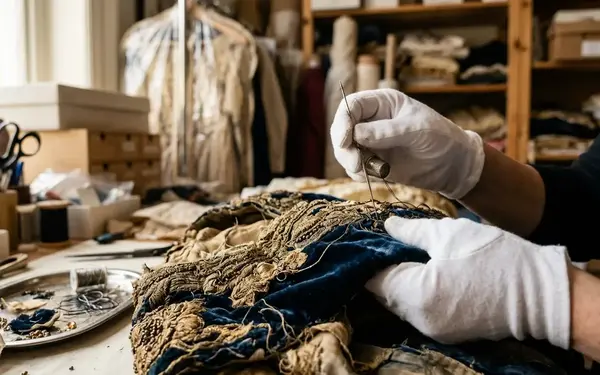
To achieve this structural tension, stylists increasingly pull from archival menswear collections. Sourcing vintage formalwear introduces historical tailoring mechanics that contemporary factory lines rarely replicate:
- Roped shoulders: Padding at the sleeve head creates a sharp ridge that catches overhead rigging lights and widens the upper frame.
- Deep double vents: Extended rear slits prevent heavy wool from bunching at the hips while walking the press line.
- Wide silk revers: Oversized satin or grosgrain lapels widen the reflective surface area across the chest, maximizing tonal contrast under direct flash.
Subverting Formalwear Codes: Sheer Shirting and Statement Brooches
Dismantling the penguin suit starts at the chest plane. Removing the stiff cotton marcella bib shirt in favor of sheer silk organza, chiffon, or fine-gauge mesh eliminates the rigid central barrier of traditional formalwear. By discarding the bow tie and exposing the collarbone and underlying skin tones, sheer bases soften the severe frame of a heavy wool dinner jacket and alter its textural balance.
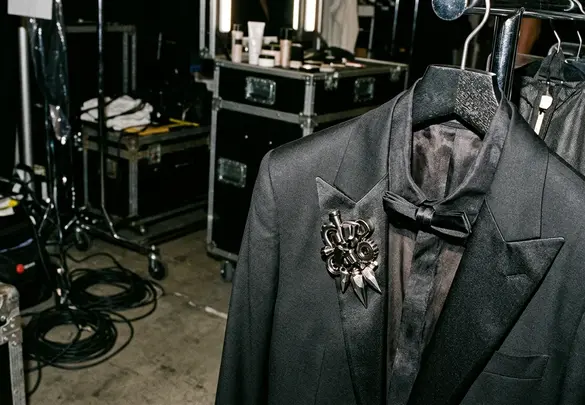
Different sheer textiles behave under distinct physical mechanics. Silk organza maintains a crisp, translucent planar volume that holds its structure independently beneath a tailored coat. Silk chiffon and fine-gauge mesh lack that internal rigidity and collapse directly against the skin, requiring weighted collar pins or brooches to keep the neckline from shifting unevenly underneath the jacket revers.
High-jewelry brooches and metallic hardware fulfill both a mechanical and a visual role in this setup. Moving far beyond a decorative cloth boutonnier, heavy precious-metal pieces anchor asymmetrically draped lapels, weight down sheer fabric collars, or cluster across the chest plate to catch directional press lighting. Hardware placement succeeds when the brooch or pin cluster rests flat against the chest plane without tilting downward, confirming that the internal canvas interlining supports the metal's leverage.
Press Line Fit Failure
Combining delicate sheer shirting with an overly snug, slim-cut jacket triggers an immediate structural breakdown. When the outer wool coat pulls laterally across the button stance, it compresses the sheer silk organza or fine-gauge mesh underneath, bunching the base fabric into strained horizontal stress wrinkles that destroy a clean vertical drape.
Deliberate structural tension demands breathing room between the translucent base layer and the outer tailoring. The jacket must hang freely from the shoulders so the sheer fabric underneath can sit without lateral torque.
Adapting Red Carpet Menswear Mechanics for Black-Tie Events
Translating editorial carpet mechanics into a personal formal wardrobe requires disciplined calibration so the ensemble reads as sharp eveningwear rather than theatrical costume. Before altering the traditional formula, verify the venue's dress code administration: strict black-tie entry enforcement at private clubs, diplomatic functions, or traditional balls bars open-collar tonal silk shirts and missing neckwear at the door, which restricts the unfastened top-button adaptation to hospitality black-tie gatherings and standard social galas.
For an event where contemporary black tie is welcome, you can execute a high-contrast architectural look by working through a precise five-step build:
- Establish the formal frame: Start with a classic single-breasted Barathea wool dinner jacket built with a grosgrain peak lapel. The matte weave of the Barathea wool absorbs ambient room light, while the corded texture of the grosgrain lapel provides a subtle focal edge without the mirror glare of cheap satin.
- Swap the base layer: Replace the traditional white pleated dress shirt and bow tie with a tonal charcoal silk-blend button-down. Leave the top button unfastened to expose the base of the throat. If the silk-blend shirt uses an unstructured collar band that collapses inward and disappears beneath the jacket when unfastened, slide rigid metal collar stays into the underside pockets so the collar points stand upright against the grosgrain revers.
- Reset the lower proportion: Tailor the matching wool trousers to sit high at your natural waist, completely eliminating the belt or low-hip waistband. Hem the cuffs to rest with a full break over patent leather Opera pumps. You have hit the exact measurement when the front trouser crease rests on the vamp of the pump to form a single distinct horizontal fold, while the back hem clears the heel counter without dragging on the floor.
- Anchor the hardware: Select a single weighted sterling silver or vintage stone brooch and measure two inches below the left lapel notch. Push the pin stem directly through the Barathea wool and the internal horsehair lapel canvas.
- Reinforce the backing: Before clasping the pin shut, thread a hidden felt backing washer onto the stem behind the lapel. The felt washer distributes the downward pull of the heavy metal across a wider surface area, ensuring the wool lapel stays crisp and flat rather than sagging over a five-hour evening.


Your Thoughts
No comments yet. Be the first!
Your Comment